Tuesday, 28 January 2014

The Power of Song

Each morning the students of Ricks Institute gather at the flag pole, standing in rank by class, for the start of a new day. At 7:30 the day is young and the promise of dawn is fresh. 
With the exception of the Pledge to the Flag of the Republic of Liberia—to which we will turn in a future post—the daily ceremony is sung. Every day six hundred or so voices fill the air with “the school ode!” as the leader of the ritual announces it. 
Most days the same choir successfully completes a rather difficult anthem, “All Hail, Liberia, Hail.” It is difficult because of the range required for voices of all ages. It is made more difficult by a dramatic pause mid-way through (sometimes I see the younger children counting to four to be sure not to jump in too soon).
A few days the fading dawn is greeted with “The Lone Star Forever,” with the memorable and apt words 
When freedom raised her glowing form
on Montserrado's verdant height,
She set within the doom of night,
'midst low’ring stars and thunderstorms
the star of liberty—and seizing from the waking morn,
its burnished shield of golden flame,
she lifted in her proud name
and raised a nation long forlorn
to noble destiny.
18th President of Liberia
1930-1944
The patriotic hymn was written by Edwin James Barclay (1882–1955), Liberia’s eighteenth President. His administration was born in scandal and rested in the glory of Liberia taking her place on the global stage with the Allies in World War II. The immediate predecessors (President C. D. B. King and Vice President Allen Yancey) of Barclay’s administration were swept away when their complicity in a later-day slave trade was exposed (King and Yancey allegedly benefited from corvĂ©e associated with the domestic workforce and outright slave trading with the Spanish). Secretary of State at the time, Barclay was selected to finish King’s term; he was elected in 1931.
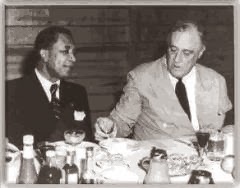
Presidents Barclay and Roosevelt
in 1943
 During the fourteen years of his administration, Barclay restored international respect for Liberia, greatly improved the economy, and became a trusted ally of U. S. President Franklin D. Roosevelt. Barclay was instrumental in the construction of Robertsfield—with runways long enough to welcome Allied Forces planes; perhaps Barclay’s legacy is negotiating with Pan American Airlines to make Monrovia a destination for international travelers. In 1943 FDR visited Liberia en route to a summit in Morocco; later that year Barclay was welcomed in Washington, D. C. and was the first black person to stand at the rostrum in the U. S. Capital as an honored head of state.
Barclay’s patriotic hymn focused upon the dawn of Liberia in the 1820s, but the song’s power is in part that it also touches upon so many new dawns that Liberia has greeted in her troubled history.
 Each time I hear the Ricks students sing, “When freedom raised her glowing form on Montserrado's verdant height, she set within the doom of night, the star of liberty—and seizing from the waking morn, she lifted in her proud name and raised a nation long forlorn to noble destiny,” I rehearse the recent horrors of war and know, for sure, that the Ricks students understand “a nation long forlorn.”
Daniel Bashiel Warner
Liberia's 3rd President
1864-1868
Liberia’s third President, Daniel B. Warner [image] wrote “All Hail, Liberia, Hail.” It is a song that captures the Zeitgeist of mid-nineteenth century for the hope of the end of slavery and the greater hope of a land of freedom for “a race benighted race”: 
All Hail, Liberia, Hail!
This glorious land of liberty shall long be ours.
Though new her name green be her fame
And mighty be her power
In joy and gladness with our hearts united
We'll shout the freedom of a race benighted
A home of glorious liberty by God's command. 
Liberia was the focus of hope for abolitionists, slaves in “the new world,” and free people of color for whom freedom already being compromised by political and economic realities in the Americas that were determined to establish a two-tiered society based upon race. And, for most of the hopeful, it was “God’s command” that would bring their hopes to fruition.
“And mighty be her power. And mighty be her power.”
In the midst of persistent challenges, Liberians hold to the claim that Liberia is blessed by Providence with “mighty . . . power.” When I hear the children sing those lines I know that they believe in the power (pun intended) of the song. I know it because, even in the midst of confusion and poverty and struggle, the children and their teachers and their public leaders refuse to capitulate to the despair that lurks in every shadow. 
All Hail, Liberia, Hail!
In union strong, success is sure
We cannot fail
With God above our rights to prove
We will over all prevail
With hearts and hands, our country's cause defending
We'll meet the foe with valor unpretending.
 The theme of Providence appears, again: “With God above our rights to prove / We will over all prevail.”
 These same themes of hope and divine guidance permeate the Ricks Ode, too, written in the mid-twentieth century by Baromi Morris, well-known Liberian jurist and musician.


Stella Polaris, O, Ricks Institute,
Thy way to greatness and prosperity;
Ye we point to glorious Ricks for fame and victory.
With God before us, success we are sure,
Upward and forward the victor we go;
Therefore with uplifted eyes
We are sure to win the prize.


On the days when the students sing the Ricks Ode and The Lone Star Forever, I am always struck by how the songs carry the singers and listeners from the dark of night—the invocation of the North Star in the Ode—to the dawn of perpetual new days—“and seizing from the waking morn' . . . [Freedom] lifted in her proud name and raised a nation long forlorn to noble destiny” from Lone Star.
Taken together, these three songs have a power that, I hope, will sustain the students, faculty at Ricks, and any other who has the opportunity to be present for the morning flag ceremony.

Wednesday, 22 January 2014

Rhianna's Stage


She doesn't need of all of both hands to count to her age. With only part of one hand she can let you know she is in grade 4. This is the first year she has had classes in the main school building, which means this year is the first year she gets buffeted by the bigger, louder, and more savvy students at Ricks Institute.
Today, however, Rhianna Musa stepped onto the biggest stage any nine-year old could imagine, short of discovering super powers and saving the planet.
It is exam week at Ricks Institute, the last days of the first semester. With characteristic gravity, Principal Olu Q. Menjay has been warning the students this week: “The last days are dangerous days,” he says. “You must be careful; these are dangerous days.”
The danger has nothing to with “the end times” associated with the lore of popular Christian science fiction. These last days at Ricks are fraught with the threat of failing an exam, or a grade, or getting expelled for “spying,” the by-word at Ricks for cheating.
All week Menjay has been warning the older students to review their lessons. “We are behind in Liberia,” he says. “If a ninth-grader can do grade 7 work, fine. But we have to catch up.” Today he put it to the test and set the stage for Rhianna Musa, grade 4, nine-years old.

Out-of-the-blue, the Menjay Way, in the middle of something else, he asked, “Who knows the ‘times tables’?” A number of fourth-graders shot their skinny arms in the air in the way that fourth-graders around the world must. Randomly, Menjay called a girl to the front of the auditorium to face more than 600 students. 
Then Menjay saw a drowsy student in one of the upper grades: “Hey!” he said, pointing, “you sleeping?” Soon, the offending lad was on his feet, squared off in a times table competition—with a fourth-grade girl half his size.
“Times five,” Menjay said. The lad began barely in a whisper. “Speak up! They need to hear you in the back!” As Menjay slowly walked toward the back of the hall, the boy faltered, “Five times seven equals forty.”
The auditorium erupted in nervous glee because more than 600 students had been spared, they thought, the very public oral exam.
Menjay turned to the waif: “Times five,” he said.
Rhianna Musa stood up straight, spoke in a loud voice—suitable for out-of-doors—and rattled off the “fives” from one to twelve.
Menjay called up another upper-class student. “Times six,” he ordered, and slowly walked away. (I turned my attention to Rhianna and noticed her softly doing the “sixes” in her own way, warming up in case the bigger, now quieter, student stumbled.) And, he did: “Six times three equals twenty-four.” The hall howled. Menjay pointed to Rhianna and she executed the “sixes” in the same strong voice and rhythm as she had completed the “fives.”

She showed no pride or excitement, but she did gently cross herself (yes, there are Liberian Catholics). 
The game was on! Seventh-graders, tenth-graders, twelfth graders, eighth-graders, and ninth-graders all had the chance to boast of the chance of defeating the Fourth Grade Wonder: Rhianna Musa. Eight tried and eight failed. Each time Rhianna made it through whatever Menjay asked. And each time she crossed herself in a gentle way.
Then Menjay made his point, standing next to a high school student who failed and wept. “We are behind in Liberia. But, we can catch up.” As Menjay made his speech about catching up and what hard work it is, I motioned for Rhianna. I asked her name and told her I was proud of her courage and excellent recitation. Then I slid a Liberian $50 bill across the desk where I was sitting. For the first time I saw her smile.
When Menjay was done, the assembly was dismissed. The other fourth-graders mobbed Rhianna as if she had scored the winning goal of a football match, and shared with her the day she took the stage.

Tuesday, 14 January 2014

The Economy at Work

Again I saw all the oppressions that are practiced under the sun. 
Look, the tears of the oppressed—with no one to comfort them! 
On the side of their oppressors there was power
with no one to comfort them.  ~ Qoheleth 4.1 ~

Last Saturday I had the luxury of passing through Duala as a passenger instead of the driver. Usually I am at the wheel with 12-15 passengers on the way to an appointment in Monrovia, or by myself making a grocery run.
As a driver I see a lot in Duala. As a passenger I saw even more.
Duala is about half-way between Ricks Institute and Monrovia. That puts it near the heart of Bushrod Island, which has a high population of struggling Liberians and small population of economically stable—even comfortable—international business people.
Unemployment in Liberia is about 85%. What jobs are available usually are passed out in accord with a patronage system that has endured since the 1940s. If you get a job and get some influence you make sure that your family and friends are next in line for a job, no matter how small.
That leaves a growing population of poor and uneducated people crowded together in squalid housing, if you can call an abandoned shipping container, or four walls of woven palm-frond with a plastic tarp roof, housing.

Duala bustles every day  the under the sun. It is a picture of the economy at work.
Here is how it works: International business people, most from the Middle East, own the traditional business like supermarkets and hardware/building materials stores that dot both sides of the road that cuts through Bushrod Island. Duala is the place the indigent and eager gather day-after-day. The lucky ones find something like a job as a porter or as a vendor.
There are wheelbarrows everywhere—thus, the porters. The contents of those barrows range from fresh produce to grains to bread, to various meets, to palm oil, to clothing. The porters carry disposable goods to the vendors who sit under the sun, or, perhaps, under a large umbrella advertising  beer or a cell phone company.
Where do these disposable good come from? One hundred feet, or so, back from the road there are modest warehouses, some nothing more than abandoned shipping containers (there are a lot of them in Liberia), stacked full of 50 kg bags of rice (from China), or tires, or plastics, or recycled clothing, or knock-off sports shoes, and the like.
The international merchants buy in bulk and break down, for example, a 50 kg bag of rice into zipper bags of a few ounces, or a wheelbarrow full of rice will be delivered to a vendor who, in turn, measures out rice in a rusty can, according to her customer’s desire. And, yes, “her” is right.
Duala is the place one can buy one tablespoon of mayonnaise.
Here is the economy at work: The international merchants own the merchandise and the wheelbarrows. Porters and vendors are consignment workers. They pay up front for what they carry and/or hope to sell. With each transaction the price goes up, of course. Everyone needs to turn a profit, no matter how small (except for the international merchants who always  get their money up front). And, yes, the international merchants collect rent on the wheelbarrow.
There have been efforts to supply porters with a personal wheelbarrow, but the efforts have failed. Unless a porter pays the rental fee, no merchandise is available to move around Duala to the vendors.
So, what I see in Duala are the tears of the oppressed. The tears are not always literal, but the pained expressions, the blank expressions, and the occasional angry outburst between porters and vendors, all are tears, literal or symbolic.
And what of the merchants—the international merchants? They endure the scorn of Liberians who lack economic power. “Lebanese” is a four-letter word in the mouth of many Liberians. They have (economic) power, but there is no one to comfort them.
Liberia is the only country in the world that refuses citizenship to all except those who can document a shred of African ancestry. I understand that, given Liberia’s beginnings as a colony—and then a republic—for freed slaves.
My point is not about Liberia citizenship. (Perhaps I’ll address that later.) My point is that the power of the oppressors excludes them from comfort in the same way that the oppressed are not comforted.
Both the oppressed and the oppressor yearn for liberation. That, for ill, is how the economy works.

Tuesday, 7 January 2014

Settling In

Written on 5 January 2014
   I’ve been in Liberia, this time, less than twenty-four hours. That is less time than it took me to get here. Lucy and I left Macon around 2p on 3 January. My plane touched down in Monrovia at 7:30p, local time (with a four hour time difference that was 24.5 hours from Macon to Monrovia). It was nearly 11p, however, before I was in my place at Ricks Institute.
   
leaving Charles de Gaulle
West African sunset @ 35K feet
 Between Macon and Monrovia I saw the ATL skyline from above; the lights of Dublin, Ireland, predawn; the grey, blustery morning in Dublin as I walked to the commuter plane that would take me to Paris; Charles de-Gaulle airport in mid-morning fog; a well-defined Iberian peninsula; the reddish sands of the Sahara; and, finally, the coast of West
Africa at sunset.
   Each time I arrive in Monrovia (this was the tenth time) I see evidence of changes for the better. The arrival process, including baggage claim, was so much better this time than the last. I’ll not begin to compare it to my first adventure in 2007.
   The havoc I had come to expect was gone. There was order and efficiency with the baggage handling. There were fewer folks in line filing “lost bags” paperwork. AND, the air-conditioning was working well.
six of my new colleagues from LBTS
   I was pleased to Olu Menjay waiting for me. I was surprised to learn that Rev. Toby Gbeh and six of the seminary staff were also there to greet the plane.
   Olu and I navigated the less-than-usual press of porters in the parking lot. (At times there have been a dozen or more men and teenagers, or younger, eager to claim the right of carrying a bag in return for a US dollar.)
   I learned that my house on the Liberia Baptist Theological Seminary (LBTS) campus was not ready, and that I would be at Ricks for a week. That is fine. It will give me a chance to see folks AND get some work done in the quiet of the guest house.
   The trip was tiring. I did not sleep at all on the first leg to Dublin. My mind was too busy and I had to get it focused. The first step was to find some background music, so I could test the noise-cancelling headphones Lucy gave me for Christmas. I had Beethoven piano and Vivaldi cello. The headphones worked wonderfully well.
   Reading has a way to quell my often too-active mind. I picked up a dense and technical essay by Harnack (turn of the twentieth century German historian of the church) on the origins of the Apostles’ Creed. In addition to learning more about the Creed, Harnack forced me to call up my Greek and Latin—in the style of his era, he assumed readers could navigate basic passage and, therefore, no translations offered. I had to make a short list of vocabulary that failed me, but in the end I managed to work through the 100 pages with the desired result of quieting my mind.

   
Rowan Williams
Alas, then I was keyed up in another way! So, I picked up Rowan Williams’ (former Archbishop of Canterbury) 2001 revised edition of his 1987, Arius: Heresy and Tradition. I previously had read the 1987 work, but had saved the revision—which Williams merely added as appendices—for later.
   By then I was in Dublin.
   Fearing that I would fall asleep and miss my connection to Paris, I found a hard chair at the gate and picked up a third book: Raimon Panikkar’s Christophany. I’ve been reading Panikkar for 35 years, but this book was/is a challenge.
   As a brief aside, these disparate readings are related to some projects I have before me. One is an attempt to sort out what “heresy” is, and the other is an independent reading course I agreed to do in 2014 with my student, Bandon Brock.
   While I was waiting to board the plane to Monrovia I found myself sitting next to an older man who looked, to me, to be Liberian. We struck up a conversation, in the end, what may become a friendship. Turns out that, in the end, I was sitting with Dr. Eugene Sawyer, a Liberian physician who for the last 30 years (that would have been early in the Doe administration in Liberia) has lived and worked in Michigan. Our time was rich and promising. We will meet, again, in the days ahead before he returns to the US.
Amos Sawyer
   Dr. Sawyer is the brother of Amos Sawyer. Wow. In Liberia’s darkest days in the 1980s and beyond, Amos Sawyer was one of the few who stuck it out and held high the dim light of liberty, hope, and justice.
   My mind was, again, racing when I boarded the plane in Paris. I found Bach on the system, picked up, again, Christophany, read until lunch was served, had two glasses of wine, and slept for five hours.
   Now, I am in Liberia. I am content. My mind is not racing. I am well rested after 10+ hours of sleep since I arrived.
   Today I have seen two of my Liberian sons, Faliku and Edmond. In them I see the success of Mercer’s partnership with Ricks and beyond. In them I see the beginnings of hope realized.
   The days, weeks, and months ahead will be full, I am sure.
   Now, I am in Liberia. I did not plan to be here this year, but I am. I am eager to meet the calling that brought me here. I miss home, already, too.
   To have two rich lives in two places at the same time is a gift. I know that. I am grateful for it.

Thursday, 2 January 2014

A New Horizon

   I'm returning to Liberia.
   The return was not in my plan. It bubbled up. It surprised me. Indeed, it confounded me.
When I went to Liberia--returned to Liberia--in January 2013, it was as a researcher. I went looking for Edward Wilmot Blyden, an under-appreciated giant of nineteenth century intellectual history who changed Liberia through his passion for education and promoted Liberia as a diplomat with stunning successes.
   For the last year I have lived with the legacy of Blyden: Linguist. Scholar. Journalist. Educator. Statesman. Pioneer. Explorer. Bridge builder between Christian, Muslim, and traditional West-African religions.
   Along the way I began to see Blyden as a potential key for a future, not only in West Africa, but more broadly in Christian-Muslim engagements.
   A subtext emerged. I was "theologian in residence" at Ricks Institute from January 2013 until early March. I gladly embraced that role. In addition to doing research on Blyden--including an enlightening trip to Freetown, Sierra Leone--I tried to learn more about Liberian Baptists.

   I went to Greenville in Sinoe County, which is 150 miles from Monrovia. I went to Edina in Grand Bassa County, where the Liberia Baptist Missionary and Education Convention (LBMEC) was formed. I visited the grave of Joseph James Cheeseman, founder of the LBMEC (1880) and President of Liberia (1892-1896).
   In late May I was back in Liberia, this time with a group of Mercer University students from the Tift College of Education. Since 2008 Mercer on Mission has had groups of students at Ricks Institute, a K-12 boarding school near Monrovia.
    Mercer has a growing partnership with Ricks and, by implication, with Liberia.
Bradley Brown Chapel at the Liberia Baptist Seminary
      In early June I was in the company of Rev. Dr. Olu Q. Menjay, Principal at Ricks and President of the LBMEC and Rev. Dr. Craig McMahan, Director of the Mercer on Mission project at Mercer. We took a break from the adventure of our Mercer on Mission students and made our way to the Liberia Baptist Theological Seminary in Paynesville City (I had been there several times before). I was the preacher of the hour for the seminary's chapel program. The service was at the Bradley Brown Chapel (named for the first President of the seminary in 1976).
   In mid-June I returned to Macon, GA and began the process of re-entering my life as a teaching theologian.
   One of the projects Menjay and I worked on while I was in Liberia was ways to expand Mercer's partnership beyond Ricks Institute. We talked about many options. In the end we wrote a paper, "What Liberia Needs," and submitted it to Mercer admin.
   By July conversations were afoot and we were beginning to open conversations on many of our campuses.
   In late August I visited with President Underwood to give an update.  He surprised me with a different agenda: "I think you need to go to Liberia as the President of the seminary." I was floored. I protested on various grounds: marital status (with profound desire to have it stay the same!), age, university policies, etc. Each time he had a response that kept things going. "At least think about it," he said. "Talk to Lucy." The conversations were frequent and focused.
Olu Q. Mejay and William "Bill" Underwood
   I accused Menjay of asking for me to come to Liberia. He was adamant in his denial. "I did not ask for you, professor. I only asked the President to help us find someone to bring some stability to our seminary." I believe him. He and President Underwood have, after all, become friends these last many years.
   President Underwood has deep commitments to the developing world. Mercer on Mission is evidence enough to support the claim, but the commitments run deeper than programs.
   Since 2009 Mercer, under President Under-wood's leadership and support, has made it possible for a dozen Liberians to come to Mercer on scholarships--with the proviso that they return to Liberia upon the completion of their undergraduate degrees. Slowly we (the Mercer/Liberia partnership) are laying a foundation for a brighter future for Liberia.
Richard F. Wilson and Olu Q. Menjay
   Tomorrow I leave for an adventure larger than any I ever imagined. Nearly 20 years ago Menjay was a war refugee sitting in my class (Introduction to Christian Theology). Now he is historian of missions and the church (Ph.D, University of Wales), a force for good in the education of children in post-war Liberia (as the Principal at Ricks Institute), and the sitting President of the Liberia Baptist Missionary and Education Convention.
   And, I must add: he will be one of my supervisors as I take up the task as President of the Liberia Baptist Theological Seminary next week.

Wednesday, 6 March 2013

Can Jews, Christians, and Muslims Co-exist?


This post previously appeared in the February 2013 issue of Baptist Studies Bulletin.
http://www.baptisthistory.org/bhhs/bsb/bsb2013_02.html


Yes.
I offer Exhibit A: the life and legacy of Edward Wilmot Blyden. Imagine a man who, as a child, lived next to a synagogue in the West Indies and attended a Dutch Reformed church. Imagine, further, the same man as a young adult who arrived in Liberia under the auspices of the New York Colonization Society and, with funding from white American Presbyterians, was educated in a mission school in Monrovia, where his fascination with Jewish history helped create a passion to learn Hebrew as a way of getting to the bottom of false claims that divine providence had assigned the descendants of Ham to a life of servitude. Now imagine the same man in the twilight of a phenomenal vocation as teacher, missionary, statesman, explorer, and activist sitting quietly in the administrative of a mosque in Sierra Leone overseeing a national program for the education of Muslim children.
Edward Wilmot Blyden (1832–1912) is the real man you imagined. His life and legacy don’t get the attention they deserve, especially in the contemporary context created by the perceived and real conflicts among the Abrahamic religions: Judaism, Christianity, and Islam. That is a shame. I add that, for those who give attention to Blyden, there is more than Abrahamic religious harmony that animated this intellectual giant of the nineteenth century. Start turning the pages of Blyden’s life and one will find the source of a broad, long shadow still visible in many places early in the twenty-first century.

In 1898 Blyden published an essay, “The Jewish Question,” in a British periodical. He began with reminiscence: “I was born in the midst of Jews in . . . St. Thomas.” He comments upon his excitements about “the annual festivals and feasts,” especially the “Day of Atonement,” recounting how he and his Christian friends assembled on “a terrace immediately above” the synagogue to “look down upon the mysterious assembly.” He concludes the introduction by noting that the “awe and reverence” of those experiences “have followed me all the days of this life.”
The essay goes on to engage the seminal work of Theodor Hertzl, the intellectual father of Zionism. Blyden suggests that “the Jew has a far higher and nobler work to accomplish . . . than establishing a political power in one corner of the earth.” He concludes: “The message of the great Zionist movement to the Jews, . . . is to rise from their neutrality and cooperating with . . . their children—Christianity and Islam—work for the saving of mankind . . . from a deadening materialism.”
Blyden’s context, West Africa, prevented him from much practical engagement of “the Jewish question,” but that was not the case with Christianity and Islam. In 1887 Blyden’s sweeping life’s work, Christianity, Islam, and the Negro Race (CINR) was published; it was so well received that the next year it came out in a second edition. The book remains in print.
The connecting thesis of CINR is driven by missions. Blyden acknowledges the common origins of Christianity and Islam in the bosom of Abraham (i.e., Judaism) while at the same time noting the differences among the religions. In the end Blyden appeals for and practically engages cooperation. His profound sense of providence led Blyden to conclude that missions should be about basic education—teaching children to read and write and think and grow in place where they are planted. Pointing to the successes of Muslim missions surrounding the mosque school where children became literate in more than the Qur’an, Blyden called for Christian missions to invest in education, too.
 He was convinced that Christians and Muslims (and, by association, Jews) could and should teach the children and make room for the spirit of God to transform Africa, not by importing foreign cultures under the guise of religion.
On 8 February 2013 I was in Freetown, Sierra Leone. It was one hundred and one years—plus one day—since Blyden died there (click the photo to the left to read the inscription on Blylden’s grave marker). My Liberian colleague and friend, Olu Q. Menjay, and I visited Blyden’s grave in the company of his great-granddaughter, Isa Blyden. For eight hours she escorted us through Freetown, 
showing us where Edward Wilmot Blyden lived out his passions for education, missions, and harmony. The highlight of the day was, for me, a visit to the mosque in the Foulah district of Freetown where Blyden established the first school for Muslim children in West Africa. We met the imam and were warmly greeted by Muslim men and women arriving for Friday prayers.

Coexistence is possible. I saw it and experienced it in Freetown.

Friday, 1 March 2013

Riding Off into the Sunrise


   Today was my last chance—on this trip—to participate in the morning rituals at Ricks Institute. I arose earlier than usual and made my way to campus as the sun was rising. A hard rain last evening and the hint of more today made for a brilliant sunrise. The clouds and low mist scattered the early beams like so much spun gold behind and above the palms.
1 March 2013
class line-ups at Ricks
   For the first time in all of my trips to Ricks I stood among the students for the raising of the flag and the singing of the School Ode and national anthem. It was a different and good perspective.
   “One-eighty-one!” the song leader cried as the students found their places in front of their seats, “One-eighty-one!” There is a short canon of songs the students select each morning. I so enjoy listening and watching the Ricks community sing. The Liberia accents bring new meaning to the words as often as not.
"One-eighty-one!"
   As the hymn began, “There’s not a friend like the lowly Jesus,” Blyden found me—and caught me by surprise. He backed me into a corner of history and showed how circumstances long past endure for generations. By the time the hymn reached the refrain for the first time 
Jesus knows all about our struggles,
He will guide till the day is done;
There’s not a friend like the lowly Jesus,
No, not one! No, not one!
I was awash in bittersweet anguish and delight. I’ve been looking for Blyden in Liberia and Sierra Leone for seven weeks. As my time draws to a close Blyden found me and backed me into a corner from which I could see past, present, and (perhaps) future in Liberia. I remembered Blyden’s clear analysis of one of the differences between African Muslims and African Christians. Islam, Blyden notes, was not hampered by a history of complicity in the slave trade; Christianity, however, would forever carry that burden. 
     Christianity, on the other hand, came to the Negro as a slave, or at least as a subject race in a foreign land. . . . The religion of Jesus was embraced by them as the only source of consolation in their deep disasters. In their abject miseries, keen anguish, and hopeless suffering they seized upon it as promising a country where, after the unexampled sorrows of this life, “the wicked cease from troubling, and the weary are at rest.”
Edward Wilmot Blyden
1832-1912
    Upon checking my memory I had the sense that Blyden was pushing me around, maybe roughly. Yes, I thought back to his gravesite and, according to his great-granddaughter’s interpretation of the kola nuts—that Blyden wasn’t listening to me. Perhaps he was listening after all. In the quotation above Blyden had cited Job 3.17, but I wondered, too, if there was a hymn in his mind as he wrote. The larger context from which the quotation comes approaches the lyrical, with references to how the [American] slaves put “new songs in their mouths—those melodies inimitable to the rest of the world—which . . . have recently charmed the ears and captivated the hearts of royalty and nobles in Europe by a tenderness, a sweetness, an earnestness, and a solemnity, born of adversity, in the house of bondage.”
Henry Hart Milman
1797-1868
   So, I searched and found a hymn by Henry Hart Milman, a contemporary of Blyden’s and Dean of St. Paul’s in London. It was a rough push. Often Blyden mentions the splendors of St. Paul’s and uses the dome as a measuring stick for other places he visited (such as the Great Pyramid of Giza). I wonder if, perhaps, they had met. As I continue looking for Blyden I will look in the corner for Milman. Milman’s “Burial Hymn” concludes:
And when the Lord shall summon us  Whom thou now hast left behind,May we, untainted by the world,  As sure a welcome find;May each, like thee, depart in peace,  To be a glorious, happy guest,Where the wicked cease from troubling,  And the weary are at rest.   
   For good measure, Blyden pushed me again. On Fridays Visiting Principal Kris Keske hands out recognitions of folks in the community who embody the values of Ricks. This morning she described the person: “She came to Ricks during the war as a displaced person and has stayed. She always goes beyond what is expected of her. She is an inspiration to us.”
Principal Keske and Mrs. Dixon
   Mrs. Dixon came forward. I’ve known her since I first came. She is a cleaning woman who works tirelessly and diligently to keep the floors clean. She sweeps and mops and mops and sweeps—everyday, all day. The smile on her face never fades. She pauses for conversation. She never asks for anything but prayers for herself and her son.

Jesus knows all about our struggles,
He will guide till the day is done;
There’s not a friend like the lowly Jesus,
No, not one! No, not one!

   Bittersweet anguish and delight. My Liberian friends have struggles I know nothing about; even my prosperous Liberian friends do. Liberia still is a place where water has to be fetched, clothes are washed in a bucket, and food is cooked over charcoal fires. The delight came from having Blyden find me—even if he did push me around a bit.